
Buying a Home
Remortgaging
Landlord
Specialist
Secured Loans
Debt Consolidation
Conveyancing
Finding a Solicitor
The Conveyancing Process Explained
Follow every stage of the conveyancing process from instruction to completion day, with realistic timelines, costs, and practical steps to keep your property transaction on track.

The conveyancing process is the legal work required to transfer property ownership from one person to another. In England and Wales, it covers everything from the point your offer is accepted (or you accept an offer as a seller) through to the day the keys change hands and the title is registered at HM Land Registry.
Every residential property transaction requires conveyancing, whether you are buying your first home, selling a property, or remortgaging. A solicitor or licensed conveyancer handles the legal side: checking the title is clean, running property searches, drafting contracts, managing the exchange of contracts, and completing the transfer.
The conveyancing process for buyers and sellers runs in parallel but involves different responsibilities. As a buyer, your conveyancer investigates the property's legal status, raises enquiries about boundaries, planning permissions, and any restrictions on the title. They also coordinate with your mortgage lender and ensure funds are in place before completion. As a seller, your conveyancer prepares the contract pack, responds to the buyer's enquiries, and arranges for the existing mortgage to be redeemed on completion.
On average, the conveyancing process takes 12 to 16 weeks from instruction to completion, though straightforward transactions with no chain can complete in as little as 6 to 8 weeks. Leasehold properties typically add 2 to 4 weeks because of the additional information required from the freeholder or managing agent.
The stages of conveyancing follow a set order, but the pace depends on factors outside your conveyancer's control: how quickly the local authority returns search results, whether the mortgage offer arrives on time, and the number of parties in the chain. Understanding each stage helps you spot delays early and keep the transaction moving forward.
The conveyancing process in the UK follows a structured sequence. Both buyer and seller work through these stages simultaneously, though each side has different tasks at each point.
Once your offer is accepted, you instruct a conveyancer or solicitor. As a buyer, they request the contract pack from the seller's solicitor, order property searches, and begin reviewing the title. They raise enquiries on anything unclear, such as boundary disputes, rights of way, or planning history. Meanwhile, your mortgage lender arranges a valuation and works toward issuing a formal mortgage offer.
As a seller, your conveyancer prepares the draft contract, gathers title documents from HM Land Registry, and completes the property information forms (TA6 and TA10, plus TA7 for leasehold properties). They respond to enquiries from the buyer's solicitor and chase any outstanding information from your mortgage lender or managing agent.
Once both sides are satisfied with the contract terms and all enquiries are resolved, you move to exchange of contracts. At this point the transaction becomes legally binding, and both parties commit to the agreed completion date. The buyer pays the deposit, typically 10% of the purchase price. Between exchange and completion, your conveyancer prepares the transfer deed (TR1) and arranges the final balance with your mortgage lender.
On completion day, funds transfer from the buyer's solicitor to the seller's solicitor. Once received, the seller's solicitor confirms completion and the estate agent releases the keys. After completion, the buyer's conveyancer pays Stamp Duty Land Tax within 14 days, submits the application to register the new ownership at HM Land Registry, and sends you a copy of the registered title once processed.
How long the conveyancing process takes depends on your specific situation. A chain-free freehold purchase with a responsive seller and no complications can complete in 6 to 8 weeks. A leasehold property in a chain of three or more buyers and sellers routinely takes 16 to 20 weeks.
Local authority search turnaround is one of the biggest variables. Some councils return results within 5 working days, while others take 6 to 8 weeks. Your conveyancer can order personal searches from a private search company, which typically come back within 48 hours, though not all mortgage lenders accept them.
Mortgage offers also affect the conveyancing process timeline. Most lenders issue a formal offer within 2 to 4 weeks of your full application, but complex cases involving self-employment or adverse credit can take longer. If the lender's valuation flags issues with the property, additional surveys or reports may be needed, adding another 1 to 2 weeks.
Chain length is the factor most outside your control. Every additional link adds a potential source of delay. If one buyer in the chain has a slow mortgage application or an unresolved enquiry, the entire chain waits. Chains of four or more regularly add 4 to 8 weeks beyond a chain-free timeline.
To keep the conveyancing process on track, respond to your conveyancer's requests within 24 hours, chase your mortgage lender or broker for updates weekly, and avoid booking removals until exchange of contracts is confirmed. Having your documents ready before instruction, including ID, proof of funds, and mortgage agreement in principle, prevents delays at the outset.
Conveyancing costs fall into two categories: your solicitor's professional fees and the disbursements they pay on your behalf. Understanding what you will pay at each stage helps you budget accurately and avoid surprises at completion.
Conveyancing solicitor cost for a standard freehold purchase typically ranges from 800 to 1,500 pounds plus VAT, depending on the property value, the firm's location, and whether you use an online or high-street provider. Leasehold transactions cost more because of the additional work involved in reviewing the lease, management pack, and service charge accounts. Expect to pay 1,000 to 2,000 pounds plus VAT for leasehold conveyancing.
Disbursements are third-party costs your conveyancer pays during the process. These include local authority searches (250 to 400 pounds), environmental and water/drainage searches (80 to 150 pounds combined), Land Registry fees (ranging from 45 to 910 pounds depending on property price), and identity verification checks (6 to 20 pounds per person). Leasehold properties incur additional costs for the management information pack, which freeholders and managing agents typically charge between 200 and 600 pounds to provide.
Stamp Duty Land Tax is the largest single cost for most buyers. First-time buyers currently pay no SDLT on the first 300,000 pounds of the purchase price. For other buyers, the nil-rate band is 125,000 pounds, with rates starting at 2% on the portion between 125,001 and 250,000 pounds. A detailed breakdown of all conveyancing fees by property price is covered in our dedicated guide.
How it works
Instruct a conveyancer
Choose a solicitor or licensed conveyancer, provide identification and proof of funds, and sign the terms of engagement. Your conveyancer begins work once they receive the contract pack or prepare it for the buyer's side.
Searches and survey
Your conveyancer orders local authority, environmental, and water searches. You arrange a property survey if buying, and your mortgage lender carries out a valuation of the property.
Raise and resolve enquiries
Your conveyancer reviews the title and draft contract, raising questions about boundaries, planning history, rights of way, and any restrictions. The seller's solicitor provides answers and supporting documents.
Receive your mortgage offer
Once the lender is satisfied with the valuation and your application, they issue a formal mortgage offer. Your conveyancer reviews the offer conditions and confirms they are acceptable before proceeding.
Exchange contracts
Both parties sign identical contracts. The buyer pays the deposit (usually 10% of the purchase price) and a fixed completion date is agreed. The transaction becomes legally binding from this moment.
Complete and register
Funds transfer on completion day and the keys are released. Your conveyancer then pays any Stamp Duty due, registers the new ownership with HM Land Registry, and sends you confirmation once registration is complete.

Property searches are one of the most critical parts of the conveyancing process for buyers. Your conveyancer orders a set of standard searches to uncover potential issues that could affect the property's value, safety, or your ability to use it as planned.
The three core conveyancing searches are the local authority search, water and drainage search, and environmental search. The local authority search reveals planning applications near the property, building control records, road and traffic schemes, tree preservation orders, and whether the property sits in a conservation area or is a listed building. The water and drainage search confirms the property is connected to mains water and sewerage and identifies the position of public drains that could restrict future building work.
The environmental search checks for contaminated land, flood risk from rivers and surface water, ground stability issues, and historical land use such as former landfill or industrial sites. If the property is in a former mining area, your conveyancer will also order a mining search to check for underground workings and subsidence risk.
Your mortgage lender will require these searches before issuing a formal offer. Some lenders also require a chancel repair liability search, which checks whether the property falls within a parish where the owner could be liable for church repairs. If any search reveals a concern, your conveyancer will raise it as an enquiry with the seller's solicitor or advise you on indemnity insurance options. For a full explanation of each search type and what the results mean, see our guide to conveyancing searches.
Exchange and completion are the two defining moments in any property transaction. Understanding what happens at each stage, and the gap between them, helps you plan your move and protect your position.
Exchange of contracts is the point at which the sale becomes legally binding. Before exchange, either party can withdraw without penalty, though they will lose money already spent on surveys, searches, and legal fees. At exchange, both buyer and seller sign identical contracts, the buyer pays the agreed deposit (usually 10% of the purchase price, though this can be negotiated), and a fixed completion date is set. From this moment, pulling out carries serious financial consequences. As a buyer, you forfeit your deposit. As a seller, you could face a claim for the buyer's costs and any difference in the eventual sale price.
Completion typically follows exchange by 1 to 4 weeks, though you can exchange and complete on the same day in certain circumstances, such as chain-free transactions or auction purchases. On completion day, the buyer's solicitor transfers the remaining purchase funds to the seller's solicitor by bank transfer. Once the money clears (usually by early afternoon), the seller's solicitor confirms completion and the estate agent releases the keys to the buyer.
After completion, the buyer's conveyancer handles several post-completion tasks. They submit the Stamp Duty Land Tax return and payment to HMRC within 14 days. They then apply to register the new title at HM Land Registry, which currently takes 4 to 6 weeks for standard applications. Once registration is complete, you receive confirmation of your ownership and a copy of the updated title register.
The conveyancing process works differently in Scotland compared to England and Wales. If you are buying or selling property north of the border, you need to understand the key differences before instructing a solicitor.
In Scotland, the seller typically puts the property on the market at an "offers over" price. Interested buyers submit sealed bids through their solicitor by a set closing date. The seller's solicitor reviews all offers and selects the winning bid. This sealed-bid system means buyers rarely know what competing offers look like, and gazumping is far less common because the process moves more quickly from offer to a legally binding agreement.
Once an offer is accepted in Scotland, the buyer's and seller's solicitors exchange a series of formal letters called missives. These letters set out the terms of the sale, including the price, completion date, and any conditions such as a satisfactory survey or the sale of the buyer's existing property. When both sides agree on all terms, the missives are "concluded" and the contract becomes legally binding. This is equivalent to exchange of contracts in England and Wales, but it typically happens much earlier in the process.
Completion in Scotland is called the "date of entry." On this date, the buyer's solicitor transfers the funds, and the seller hands over the keys. The buyer's solicitor then registers the title with Registers of Scotland rather than HM Land Registry. Scotland also uses a different set of property searches, including a property enquiry certificate from the local authority and a coal mining report where applicable.
Northern Ireland follows a system closer to England and Wales, with separate exchange and completion stages, but uses the Land Registry of Northern Ireland for title registration. Solicitor fees in Northern Ireland tend to be slightly lower, averaging 500 to 1,000 pounds plus VAT for a standard residential transaction.
Even straightforward transactions can hit problems. Knowing the most common issues and how to respond helps you avoid delays and protect your position throughout the conveyancing process.
Whether the property is freehold or leasehold has a direct impact on the conveyancing process, the timeline, and the overall cost. Understanding these differences before you instruct a solicitor helps you set realistic expectations for your transaction.
Freehold conveyancing is more straightforward. Your conveyancer checks the title, runs standard searches, reviews the contract, raises enquiries, and manages exchange and completion. There is no lease document to review, no managing agent to contact, and no service charge history to verify. Most freehold transactions complete toward the faster end of the 8 to 16 week range.
Leasehold conveyancing involves additional layers of work. Your conveyancer must review the full lease document (often 40 to 100 pages), request a management information pack from the freeholder or managing agent, and verify ground rent amounts, service charge levels, and any planned major works. They also check the remaining lease length and whether any building safety issues apply under the Building Safety Act 2022, which introduced new requirements for residential buildings over 11 metres tall.
The management information pack alone can take 2 to 4 weeks to arrive, and the cost (200 to 600 pounds) is usually paid by the seller. This frequently causes delays if the managing agent is slow to respond. For a property with a lease below 80 years, marriage value applies to any lease extension, increasing the premium significantly. If you are considering a leasehold purchase, factor in the additional time and cost from the start to avoid surprises later in the process.
Why compare with us
Conveyancing is the legal process of transferring property ownership from one person to another. It covers all the legal work involved in a property transaction, including checking the title, running property searches, drafting and exchanging contracts, and registering the new ownership at HM Land Registry. A solicitor or licensed conveyancer carries out this work on your behalf. Both buyers and sellers need conveyancing, and the process applies to purchases, sales, remortgages, and transfers of equity.
The conveyancing process typically takes 12 to 16 weeks from instruction to completion, though this varies significantly. A chain-free freehold purchase can complete in 6 to 8 weeks, while a leasehold property in a long chain may take 16 to 22 weeks. The main factors affecting the timeline are local authority search speeds, mortgage offer processing times, the number of parties in the chain, and how quickly both sides respond to enquiries from their solicitors.
A solicitor is a qualified lawyer who can handle conveyancing alongside other legal work, regulated by the Solicitors Regulation Authority. A licensed conveyancer is a specialist who focuses exclusively on property law, regulated by the Council for Licensed Conveyancers. Both can carry out residential conveyancing to the same standard. In practice, the quality of service depends more on the individual firm's experience and caseload than on which type of qualification they hold.
Yes, exchanging and completing on the same day is possible and happens regularly in chain-free transactions and auction purchases. Your solicitor needs all searches, the mortgage offer, and signed documents ready before the exchange. Same-day transactions carry more risk because if anything goes wrong after exchange, you have no time to resolve it before completion. Most conveyancers recommend a gap of 1 to 2 weeks between exchange and completion to allow time for final preparations and removals.
Pulling out after exchange has serious financial consequences. As a buyer, you forfeit your deposit, usually 10% of the purchase price, and may face a claim from the seller for additional losses such as the cost of relisting the property or any difference in the eventual sale price. As a seller, the buyer can pursue you for their wasted survey fees, legal fees, and mortgage arrangement costs. Withdrawal after exchange is rare because of these penalties.
The standard deposit at exchange is 10% of the purchase price, paid by the buyer to the seller's solicitor. In some cases, a reduced deposit of 5% can be negotiated, particularly if you are using a high loan-to-value mortgage and do not have 10% available in cash. The deposit is held by the seller's solicitor as stakeholder until completion. If you pull out after exchange, you lose the entire deposit to the seller.
You should arrange buildings insurance from the date of exchange, not completion. Once contracts are exchanged, the buyer takes on the risk of damage to the property under standard contract conditions in England and Wales. If the property is damaged by fire or flood between exchange and completion, you are still legally obliged to complete the purchase. Most mortgage lenders require evidence of buildings insurance before they release funds. For leasehold flats, the freeholder's buildings insurance typically covers the structure.
After completion, your conveyancer handles several administrative tasks on your behalf. They pay Stamp Duty Land Tax to HMRC within 14 days of completion, even if no tax is due, because a return must still be filed for purchases over 40,000 pounds. They submit the application to register your ownership at HM Land Registry, which currently takes 4 to 6 weeks for straightforward cases. Once registration is complete, you receive a copy of the official title register confirming you as the registered owner.
What our clients say
Shortly after I spoke with Anna, she was also very helpful and made it effortless and a nice experience.
Had a really good experience regarding arranging a secured loan. They introduced me to a great advisor. Thanks for the help.
For once a loan transaction without stress and complications. Very impressed and highly recommended.
Thrilled to share my exceptional experience with Money Saving Advisors. The website made it incredibly simple and easy to connect with an advisor. They helped me find the best deal on my remortgage and secured a very competitive interest rate!
Great advice and money saved on mortgage.
I have previously declined a loan of the value I needed from various brokers, but this website found me a reputable broker with surprisingly decent rates.

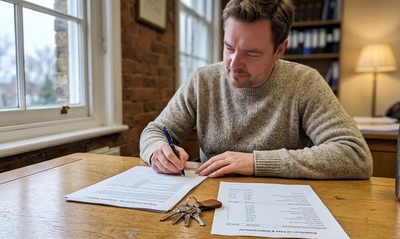
A complete breakdown of UK conveyancing fees in 2026, covering average costs, regional differences, disbursements, and how to reduce your legal fees.

Learn what conveyancing searches cover, how much they cost, and how long they take. Compare types, costs, and timelines for UK property purchases.

Find out how long conveyancing takes in the UK in 2026. Stage-by-stage timelines for freehold, leasehold, chain, and no-chain purchases.

Learn what happens at exchange of contracts and on completion day, including deposits, timelines, legal obligations, and what to do if things go wrong.